




https://ttsreader.com/ https://www.naturalreaders.com/online/


 |
||||
|
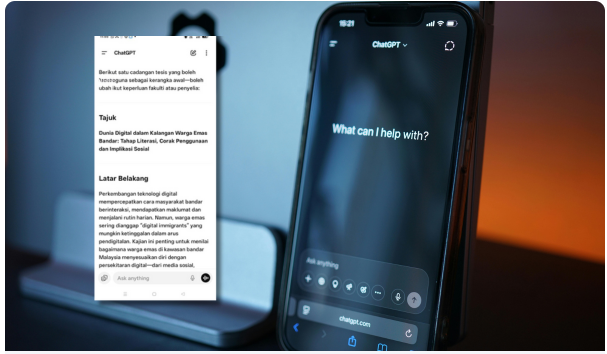
The explosion of artificial intelligence (AI) technology has brought about significant changes in the country's higher education landscape. While it offers great opportunities to accelerate the learning process, concerns regarding academic integrity are increasingly being raised among educators and policymakers. In Malaysia, it is now at a crossroads whether AI will become a tool to empower a new generation, or instead produce graduates who are "machine-smart but soulless"? Since 2023, apps like ChatGPT, Grammarly, and Quillbot have been part of the technology that has had a major impact on the lives of students, especially those in university. They are used to help students find information, write essays, translate, produce article summaries, and even provide appropriate answer suggestions for exams. According to Associate Professor Ts. Dr. Md Fauzi Ahmad, a senior lecturer from Universiti Tun Hussein Onn Malaysia (UTHM), 60% of students from universities in the Asian region use AI to complete their assignments. However, almost 38% said they were unsure whether their use contained elements of plagiarism or not.
|
 |
|||
|
Until now, there have been national statistics in Malaysia that conclude that lecturers have a 'hard time detecting' AI assignments. However, a report by Turnitin, which is widely used in Malaysian higher education institutions, estimates that 11% of assignments created contain AI-generated content.Until now, there have been national statistics in Malaysia that conclude that lecturers have a 'hard time detecting' AI assignments. However, a report by Turnitin, which is widely used in Malaysian higher education institutions, estimates that 11% of assignments created contain AI-generated content. These statistics indicate a significant gap between students’ ability to master AI and institutions’ ability to regulate its use. The uncontrolled use of AI raises serious questions about the authenticity of students’ work. The academic tradition that has long emphasized effort, critical thinking, and honesty is now facing new challenges. A 2024 Turnitin report revealed that over 22 million student assignments worldwide were identified as containing elements of AI writing. Despite the existence of detection software, its accuracy in identifying the authenticity of writing remains an issue when there are human-generated writings that are flagged or claimed to be AI content. Associate Professor Dr. Nor Shahniza Kamal Bashah, a lecturer from Universiti Teknologi MARA (UiTM), in a report by The Sun in April 2024, also called on the academic community, especially students, to be more ethical in using AI. She stated: “Academics recognize the benefits of using AI because it can enrich the learning process, but if it is used as a shortcut, it is an action that threatens academic integrity. Universities need to emphasize that AI is an assistant, not a replacement. Otherwise, we will produce graduates without an academic identity.” Meanwhile, the Ministry of Higher Education (KPT) is evaluating specific guidelines to address this issue. These include proposals to require students to attach a declaration of authenticity for assignments and to provide AI literacy training for lecturers.
Implications for Higher Education Unethical use of AI can have a profound impact on several things. Among them, the quality of graduates will be affected due to the lack of critical and analytical thinking skills in finding solutions to tasks given to them. The tendency to use AI as a shortcut makes them lazy to think, which in turn prevents critical and creative thinking through the higher-order thinking skills (HOTS) approach that was introduced since 2013. The next effect is that the reputation of a university will be affected if its academic integrity is questioned by outside parties. International recognition of the capabilities of local universities will be tarnished. Ranking bodies such as QS World University Rankings and Times Higher Education (THE) place great emphasis on academic quality and research reputation. Therefore, if there is a controversy regarding integrity, the evaluation will deteriorate further and affect the ranking position obtained. It also affects research opportunities and collaboration between universities with external parties and makes them increasingly limited. This means that opportunities to obtain international research grants, conduct student mobility programs and industry collaboration are decreasing. In addition, the subsequent impact has resulted in the digital divide becoming wider, as urban students have better access to technology than rural students. It has also affected rural students' mastery of various types of educational platforms such as AI, which is increasingly gaining public attention due to the limitations of using the latest technology, especially in the field of education.
|
Policy Needs and Actions Therefore, to prevent this matter from continuing to fester, a proactive step towards compliance with policies and good practices needs to be enforced immediately. Although Malaysia has the Personal Data Protection Act (PDPA), so far there are still no specific guidelines on the use of AI in education. Several experts believe that immediate action is needed to ensure that this technology is used ethically. Among them is the creation of national guidelines on the use of AI in education. These guidelines need to be disseminated to all through various layers of media so that they can function as intended. Furthermore, the provision of AI literacy training among students and teaching staff is seen as necessary to expose them to the functions and risks of its use. Students in particular should place limits on the use of AI in their daily academic needs where AI technology should act as a facilitating assistant and not completely take over their responsibilities as students. Now, the rate of AI abuse among students is increasing. A report from The Edge newspaper in April 2015 showed that plagiarism has long been established among students, involving more than 50% of assignments submitted by students, most of which were done without an understanding of ethics. Literacy training also plays a role in reducing the digital divide between urban and rural students. Based on a report from the Malaysian Communications and Multimedia Commission (MCMC) in 2023, it was found that the internet usage rate in urban areas was 94.6%, compared to 77.1% in rural areas. Therefore, this AI literacy training is important to support the aspirations of National Education in producing world-class education. In addition, the practice of integrating critical thinking skills into the curriculum is seen as necessary to ensure that students do not rely entirely on technology. Most students now only copy assignments completely from AI without using critical thinking skills as the original purpose of the assignments given is to test their minds and thinking skills. The next step is to invest in academic tracking and monitoring infrastructure so that institutions can manage the use of AI more effectively. Currently, tracking and monitoring platforms are still lacking and need to be improved to curb the 'copy-paste' culture, especially among students. This investment is seen as in line with the rapid development of technology so that there are effective controls and monitoring for use. The issue of AI and academic integrity is not just about technology, but about the values of education. AI has great potential to empower education, but the challenges to academic integrity should not be underestimated. Higher education in Malaysia needs to take a balanced approach—recognizing AI as a supportive tool, while upholding core values such as honesty, effort, and critical thinking. As emphasized by YAB Prime Minister Datuk Seri Anwar Ibrahim, the future of education must be balanced between technology and humanity. AI may be a student's best friend, but teachers, lecturers, and national policies remain the last bastions of academic integrity. If not addressed immediately, the country risks facing an academic credibility crisis, thus damaging the reputation of Malaysian higher education globally. |
|||
|
Article shared by: Norliyani Anor | Programme Data Section
Source from :  |
||||
Date of Input: 19/01/2026 | Updated: 11/05/2026 | aidawati

(Office of Vice Chancellor)
Level 4 The Office of The Deputy Vice Chancellor
(Research & Innovation) Building
Off Highway Sillicon
43400 UPM Serdang
Selangor