



TVET Offers Flexible Pathways To Employment | CENTRE FOR QUALITY ASSURANCE (CQA)
» ARTICLE » TVET Offers Flexible Pathways to Employment

TVET Offers Flexible Pathways to Employment


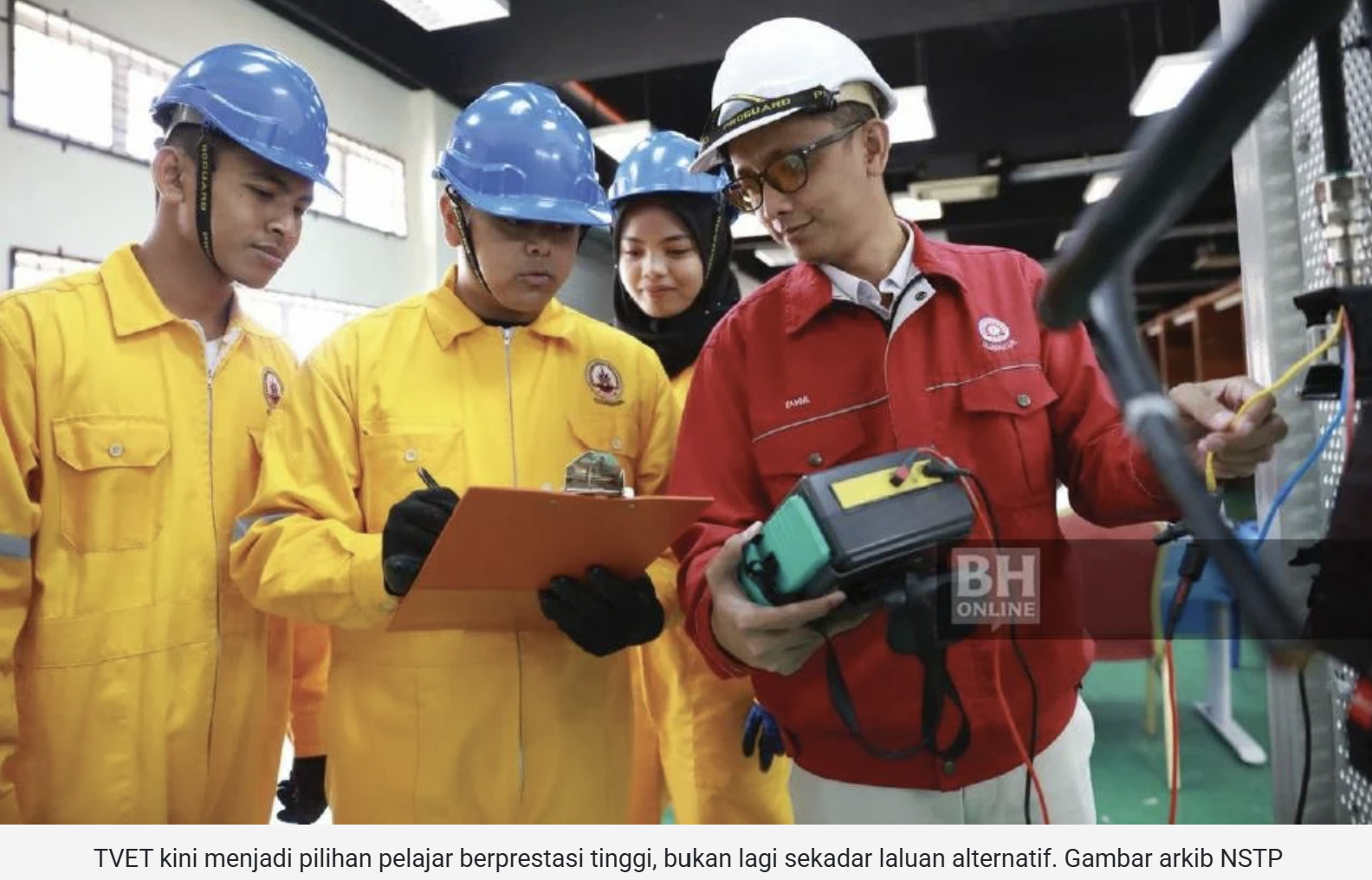
The Technical and Vocational Education and Training (TVET) pathway is no longer seen as a specific option for students who are less academically excellent, but is increasingly gaining ground among high-achieving students.

Assistant Vice-Chancellor for Strategy and Global Sustainability, Universiti Teknikal Malaysia Melaka, Associate Professor Dr Musthafah Mohd Tahir, said technological developments and the 4.0 Industrial Revolution have seen the emergence of the Advanced TVET concept which requires students to not only excel academically, but also master technical skills and be able to think critically and creatively.

"For students with good academic ability, they are encouraged to complete their studies up to the SPM level to strengthen their knowledge base before continuing their studies in advanced TVET fields.

"This combination of academic excellence and technical skills can open up opportunities for highly skilled careers and offer more competitive income," he said.

He said that students with good academic potential should be given the opportunity to complete their SPM first before choosing a suitable study path, including at universities under the Malaysian Technical University Network (MTUN).


He said that advanced TVET requires strong theoretical mastery because the field not only demands technical skills, but also develops expertise and professionalism in various high-tech sectors.

At the same time, he said, TVET also provides a pathway for students who are less excellent in Mathematics and Science through programs that are more oriented towards practical skills such as vehicle mechanics and other technical fields.

"Those who follow the vocational path still have the opportunity to continue their studies to the diploma level and then to a higher level.

"After entering the workforce and gaining industry experience, they can also continue their studies through the Accreditation of Prior Experiential Learning (APEL) system," he said.

Musthafah said that students who choose TVET at an early stage usually already have a clearer career direction compared to students who follow the regular academic stream.

He said that opportunities to achieve higher qualifications remain open depending on academic achievement, industry experience and individual career development.

"Today, there are various career opportunities in advanced TVET fields that require high academic qualifications, including at the bachelor's degree level, in addition to mastery of technical skills and specialized professional certificates.

"For example, careers such as underwater welding not only require a solid foundation of engineering knowledge, but also require diving skills and intensive practical training.

"This shows that success in the TVET field requires a combination of academic knowledge, technical skills and high practical experience," he said.

Meanwhile, the Director of the Co-Curriculum Centre of Universiti Malaysia Kelantan (UMK), Dr Razman Hafifi Redzuan, said TVET and academic pathways have different focuses, but both play an important role in meeting the country's workforce needs.


He said TVET places more emphasis on practical skills and job competencies, while universities focus on theory, critical thinking and professional development.

"This difference also influences the type of career pursued, with TVET graduates more likely to become technicians, technologists, supervisors or entrepreneurs, while university graduates usually fill professional, management, research and academic positions," he said.

He said that a perception study conducted on 30 employers from local small and medium enterprises (SMEs) found that TVET graduates and university graduates have almost equal levels of ability, but TVET graduates stand out more in terms of preparedness to enter the world of work.

However, he said TVET still faces challenges in terms of recognition equivalent to academic pathways, particularly in relation to qualification equivalence, credit transfer and public perception that still considers TVET as a second choice.

Razman Hafifi said parents and students need to make choices based on interests, abilities and career aspirations, not just academic achievements.

"For students who aspire to become entrepreneurs or work independently, the TVET route as early as age 16 may be a suitable option, while for those aiming for professional careers and management positions, completing SPM before continuing their studies to a higher level may be more profitable.

"If a student is weak in Mathematics and Science, it may be difficult for them to choose engineering, but that does not mean they are unsuitable or will fail if they choose TVET.

"This is because the field offers various programs other than engineering, with levels of study that can be adjusted according to students' abilities and interests," he said.

    

Article shared by: Kasmaria Zawawi | Documentation Section 

Source from:

Date of Input: 20/07/2026 | Updated: 20/07/2026 | aidawati

MEDIA SHARING

CENTRE FOR QUALITY ASSURANCE (CQA)
Universiti Putra Malaysia
43400 UPM Serdang
Selangor Darul Ehsan
03-9769 1508
03-9769 1489
X, (05:50:22pm-05:55:22pm, 21 Jul 2026)   [*LIVETIMESTAMP*]